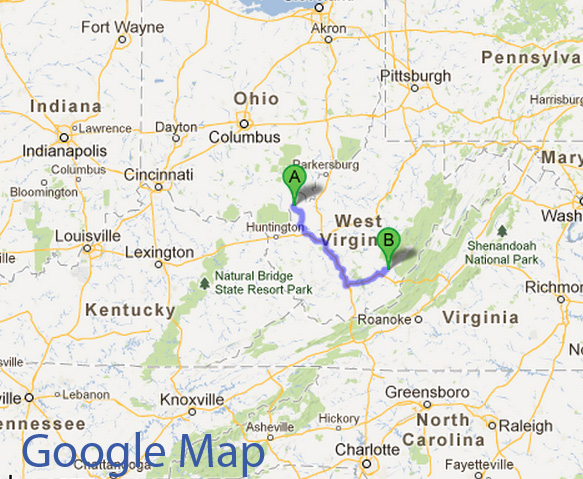
From Fort Randolph to Fort Donnally
In my last post I hope I cleared up that the Major John Pryor who received the 4000 acres of bounty land in Kentucky was not killed by Indians.
William Pryor of Amherst Co., formerly Albemarle Co., gave an account of his service as part of his 1832 application for a Revolutionary War Pension. He states he moved to the Kanawha area in 1773 but was driven out by Indian attacks. He mentions his brother, John Pryor, who in 1778 was living at Fort Randolph (located at Point Pleasant in Kanawha County) and traveled more than a hundred miles to Fort Donnally to warn of an Indian attack:
Capt. McKee called for two men to go and appraise the Greenbrier settlements. John Intchminger and John Logan volunteered, but returned; then Philip Hammond and applicant volunteered, but applicant’s brother, John Pryor, took his place, being more experienced. They followed the Indians and passed them about ten miles from Donnelly’s Fort, where they arrived and gave the alarm.
I’ve seen some researchers who combine John Pryor’s death into the events at Fort Donnally. William didn’t say he died in the attack.
I found a wonderful source at Fort Randolph.org (Wayback Machine link. This site compiles accounts from letters written close to the time and Revoutionary War pension applications to draw out the facts that John Pryor was living at Fort Randolph in 1778 and that by July 1779 the fort had been burned out by the Indians. John Pryor is not on the list of wounded nor recorded as one of the men killed.
The story related in History Of The Great Kanawha Valley published in 1891 states that in about 1780 John Pryor was traveling with his wife and a child. His wife and child were taken by the Indians, he was shot and he returned to the settlement only to die that evening. His wife and child were never heard from again. Many a fine researcher have noodled over the fate of this John Pryor– Did this line end with the death of his wife and child? Were other children and potential heirs left at home to carry on the line? Were his wife and child later released to carry on the family line?
I’ve found this story elsewhere. In Collections of the State Historical Society of Wisconsin, published in 1916.
John Pryor was from Albemarle County, had served in Dunmore’s War, and was stationed at Fort Randolph. According to the pension statement of his brother William, who was the first to volunteer, John was chosen in preference because of his superior knowledge of Indian ways and customs. …John Pryor was killed and his family carried into captivity during an Indian raid in 1780.
I think we can say for sure William’s brother was not killed by Indians at the time of the 1778 attack, but was he the same man killed in 1780? I found a petition filed in May 1784 requesting land for Philip Hamman and John Pryor. I also found that it was rejected.
We do certify that Phillip Hamman and John Pryor by their Resolution and Vigilance rendered an Essential Service to this Country in the year 1778, when it was discovered at Fort Randolph that a large Body of Indians had marched toward this country (Fort Donnally), they with great and imminent hazard followed after them near two hundred Miles, and having overtaken them when almost arrived at the Inhabitants did at the resque of their lives pass by and come and advertise us of their Approach… (read Wikipedia article)
So John requested land 4 years after he was killed by Indians? I considered that perhaps John Pryor HAD died and the grant was for the benefit of his family… but what family? Doesn’t the account of his death say his wife and child were carried off by Indians?
The Wikipedia article on Hamman cites a 1830 newspaper article about an event where Philip Hamman, then living in Jackson County, AL, was honored with a toast to his and John Pryor’s heroics. Interjected in the toast is this tid-bit “John Pryor (who was afterwards killed by the Indians).” I’m not ready to says that this confirms John’s death by Indians, but it does confirm that the story is attributed to the correct John Pryor.
I found Philip Hamman on the 1830 Census in Jackson Co., AL. His age helps to put John Pryor into perspective. Hamman was 70 to 79 years old, making him born between 1751-1760. I like this timeframe also for the birth of John Pryor. It makes sense that 2 young men in their 20’s, probably a couple years older and a bit more experienced than William Pryor, made the 100-miles or more trek through the wilderness to save the fort.
Was Pryor’s death at the hands of Indians an embellishment? The raid occurred in 1778 and then historical accounts place his murder in 1780 –Was he killed in 1780, yet he was able to request a land grant in 1784? Was he killed after 1784? Did Hamman embellish the story of the attack on Fort Donnelly with Pryor’s later death?– Read carefully the facts on FortRandolph.org: most sources state there were between 200 to 300 Indians gathered for the attack while in 1830 Hammon was claiming 900!
I often feel that upon examining a Pryor I’m left with more questions than before I began! After the burning of Fort Randolph in 1779 did John Pryor retreat from the Kanawha to live near Fort Donnally in the Greenbrier area? In 1780 was he living outside the fort when he was killed by Indians? Was John killed by Indians in 1780 or after 1784?
Just a final note. There are no Pryors on the 1784 Tax List for Greenbrier County.
No answers yet. Just more pieces to the puzzle. Elizabeth Pryor Harper in her book mentions that John Pryor’s death at the hands of Native Americans was mentioned in the July 1825 Louisville Morning Post. Has anyone seen this article? It may be the oldest source for this event.
Since first posting I was able to locate a copy of the 1825 Louisville Morning Post [read more]
