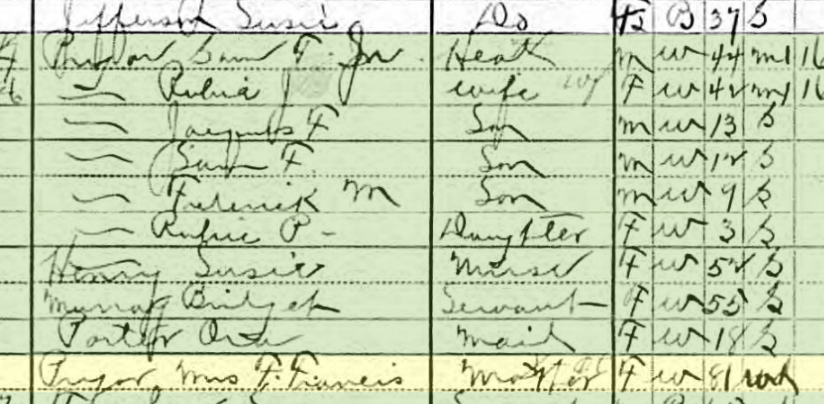
Richard Pryor In Richmond, VA and In Madison County, AL

va-pryors

Why on earth are there so many men named Richard Pryor in the 1820-1830’s? While looking at Richard Pryor of Hempstead County, AR I also noted a Richard H. Pryor in Samuel Pryor’s estate in Hardeman County, TN, then there was Richard Pryor the gamble and hothead in Catahoula Parish, LA. So why not look at one more!

Then there was Richard Pryor who was in Madison County AL. Richard was in this county as early as 1822 when he first started appearing as a named party on lawsuits. The first US census of the county wasn’t taken until 1830– his age was recorded between 30-39 years old. His presumed wife, Dolly, was 52 in 1850 so Richard may have been born close to 1798. Richard wasn’t on the 1809 Census of Madison County, so, he must have arrived in the county sometime between 1809 and 1822.

I’ve written a few times about the death of Beverly Pryor (see posts). He was killed on a Mississippi racetrack in 1836 and his father traveled from Alabama to collect his body. In 1837 Richard Pryor (about age 36-45) was appointed the administrator of Beverly’s estate (Madison Co., AL). Was Beverly 21 or older when he was killed in MS? — that would make Richard about 17-27-ish at the time of Beverly’s birth. They could be father and son.

I can’t mention Beverly without mentioning the demise of the man who killed him — he was later beheaded and it was assumed he was killed by one of the Pryors. Involved in horseracing — a revenge killing —  that would possibly describe this Richard Pryor as a “blackleg” or in our contemporary terms, a “bad ass.” I wonder if he was the Richard Pryor who was in Catahoula Parish, LA (see post).

In 1836 an Alabama Legislative act changed the name of Dolly Beverly B Harrel to Dolly Beverly B Pryor and recognized her as the legitimate child of Beverly Pryor. And she was recognized as the rightful heir of Richard Pryor. Dolly B (born 1835) was living in the older Dolly Pryor’s household in 1850. I’ve long suspected that Richard and the older Dolly were kin. An old newspaper clipping helps to ID as husband and wife.

TO RICHARD PRYOR AND DOLLY HIS wife, George W. Turner and Catharine G. his wife, Ursula D. Ragland, John Brown, —-Anderson and Octavia his wife, and A. Cook and Judith his wife.
As you are not residents of the Commonwealth of Virginia, and have no agent therein known to us, you will hereby take notice that we shall proceed on Thursday, the 28th of February, 1850, and between the hours of 9 o’clock, AM and sunset of that day, at the office of Messrs. Meredith and Young. Attorneys at Law in the City of Richmond, to take the depositions of John Sheppard, Wellington Godin* and others, to be read as evidence on behalf of the defendants in a certain suit now pending in the Superior Court of Chancery for the Richmond Circuit, in which you and others are plaintiffs, and ourselves and William Davis, Hardin Davis, Spotswood G. Waldrop, Alfred Winston, John Clash, and others, are defendants, and which suit is now on the rules docket of said court; and if from any cause the said depositions be not commenced, or being commenced shall not be completed on that day, the taking thereof will be continued from day-to-day at the same place, and between the same hours, until the taking thereof shall be completed.
JAMES S RYALL
SAMUEL DAVIS
Executors of John D Brown, deceased.
(Richmond Enquirer, February 08, 1850)

* Wellington Godin was recorded in Richmond in 1850, occupation constable.

In older posts I mused over the first name Beverly as a possibly Beverly surname connection to Major John Pryor of Richmond. Isn’t it interesting that we now know this Richard Pryor had some kind of tie to Richmond?

I’m thinking through all the possibilities. What if Richard was still alive in 1850 and still alive in 1852 to be involved in the feud in Catahoula Parish? Could the Richard in Catahoula Parish and in Madison County, AL be the same Dick Pryor who was racing horses up in Nashville? I don’t think so and will explain in my next post.

“Blackleg” Richard Pryor and A Killing In Catahoula Parish, LA


On 27 July 1852, the Woodville Republican (Woodville is in Wilkinson County, MS) reported on two homicides in Catahoula Parish, LA. These were really nasty killings where a group of men laid wait in the tall grass and behind trees waiting for their intended victims and then when their had them within shooting range, they apparently killed them while they were still seated in the buggy in a one-sided barrage of gun power. Oh yes, there was a Pryor involved!

Reading stories about the murder of these men it brings to mind mountain-men feuds. It started in 1848 between an unidentified woman and Charles Jones who was living on Black River near St. John R. Liddell. The woman shot Jones in the presence of Liddell. Jones went away for 4 years then returned with a man named Richard Pryor. The feud erupted again, leading to the event where Samuel Glenn and Moses Wiggins were waylayed and killed on the road to Trinity– allegedly killed by St. John R. Liddell. It was all a horrible case of mistaken identity because Liddell thought he was killing Charles Jones’ friend Richard Pryor!

Just so you know, these weren’t poor hill folk. Liddell was the owner of a large plantation, he had attended the military academy at West Point, and he was a friend of the future Confederate President, Jefferson Davis (see Wikipedia). Did Liddell’s position reflect later in the damaging testimony about Pryor’s character?

By 1854 the case of the State of Louisiana vs. St. John R. Liddell was in front of a Grand Jury and there’s some interesting testimony about nasty characters, smeared honor, Glen and Wiggins’ buggy was previously owned by Richard Pryor (see report in 14 June 1854 The Independent, Harrisonburg, LA ).

Witness Grant Lincecum stated he “is very well acquainted with the man Dick Pryor; has known him, off and on, for many a year.” Lincecum is on the 1850 Census in Catahoula Parish he was born 1798 in Georgia. His profession was recorded as MD– is that a medical doctor? Wouldn’t be interesting to know how their paths had crossed in the past? Perhaps there would be a clue to the identity to Richard Pryor!  The witness further testified “Pryor was a notoriously bad character–he was a gambler and a horse-racer. Witness believes that he was the worst man that ever went unhung. Witness did not testify before the Grand Jury which found this bill.”

Another witness, Mr. Laningham stated, “Pryor, Sam Smith, Emerson, Glenn and Wiggins were in the habit of coming to Trinity armed, and making threats against Liddell and his friends.”

Why did one newspaper account refer to Pryor as a “blackleg”? Well the testimony of C.C. Waters states “On the same day, Pryor, while standing on the gallery of Mr. Robb’s store, offered to bet one thousand dollars that Maj Liddell would be killed in less than twelve months from that time, and offered to give two hundred dollars to any man that would get him the bet.” He also swore, “Pryor offered to shoot the top off of the head of any of Liddell’s fighting friends who would show themselves.” Then “At one time saw Pryor and Sam Smith get their guns and go up the street towards the Saw-mill , witness believes to hunt Capt. Phillips” (a friend of Liddell’s).

Felix Robb describes Pryor as quite the colorful character: “Pryor had been but a short time in the country**, only a few weeks, and left soon after Glenn and Wiggins were killed. Pryor had no property here: witness understood that Pryor spoke of buying or of having bought some land somewhere in this Parish, but believes it was a a pretense. Pryor was a notoriously bad character, given to gambling, rioting, and fighting.”

I know you may be running login to an online census record to ID Richard Pryor. I’m thinking we can already ID him from other accounts of a hot-headed Dick Pryor.  I really don’t look for all road to lead to Tennessee but I think on this trip we’re going there again! Remember sweet old Miss Jane H. Thomas who had memories of a Dick Pryor who engaged in horse racing in Nashville? (see post). Of course there could be 2 Dick Pryors who were gamblers and horse-racers. What are the odds?

And could he be the same Richard Pryor who was using enslaved boys as jockeys at his racetrack near Nashville and maybe in Montgomery County, TN? (see post). There are just a few Richard Pryors on the 1850 Census who could possibly be the one who showed up in Catahoula Parish.

Now, because it’s always fun to know how things turned out– what ever happened to St. John Liddell? Well the feud between Liddell and Charles Jones reignited in January 1870 over a real estate deal when John Nixon was shot by C W Carmack, a cashier at the Citizens Bank. Carmack had done a slick property sale for Charles Jones without notifying the firm that employed Nixon as an agent. An article published in the Ouachita Telegraph mentions that Nixon had $20,000 in life insurance — that’s quite a chunk of change at that time. It must have been a dangerous area to be doing business.

Liddell was killed a couple weeks later. He had boarded a river boat and had sat down to dinner. Charles Jones boarded the same boat and when he came in Liddell attempted to take a shot at him, but Jones shot first, killing Liddell (read more online). Liddell also had a chunk of life insurance:

NEW ORLEANS, March 22, 1870.
To Gen. Dabnov H. Maury, Agent of Piedmont and
Arlington Life Insurance Company
My Dear Sir:– Accept my thanks for the prompt and agreeable manner in which your company has acknowledged and made payment on the policy taken out by the late Gen. St. John R. Liddell for the benefit of his daughter, Mrs. Louisa Liddell McMillan. Cordially commending your company to the confidence of your people. I remain, very respectfully, yours,
W. P. McMillan, M.D.
The Ouachita Telegraph (Monroe, LA), 30 April 1870

** I read several articles published in Louisiana newspapers which use “country” to denote locale not that some one was from a foreign country.

Edward L Pryor of Hempstead County AR and TN

Posted on by
Tennessee Pryors

All roads lead to Tennessee, right? Looking at the relationship of Charles R Pryor to the Hempstead County Pryors, I ended up looking at Edward L. Pryor again. Why? Because Edward L. Pryor of Hempstead County signed the Executor’s Bond when Charles handled Virginia Pryor‘s estate in 1865. Did he sign as a relative or because he was a neighbor?

Edward L. Pryor b. 1805. Ryburn vs. Pryor filed in Arkansas confirms his father was Samuel Pryor of Montgomery Co., TN. Samuel had 2 other known children (see Samuel B Pryor and Bernard H. Pryor of McCracken County, KY). These other children were born in 1825 and 1835, perhaps they were children from a second marriage.

Samuel was born between 1771 and 1780 when counted on the 1830 Census (Montgomery County, TN)– I told you Tennessee would come into play again! That means he was possibly in his 60’s when he died and a guardian bond was filed for the two young Pryors in 1837.

Edward L. Pryor was on the 1836 Tax List in Hardeman Co., TN. In the same year his father, Samuel’s estate was being handled through the Hardeman County Probate court. Samuel must have died without a will because E. L. Pryor (Edward L?) was appointed the administrator.

Samuel Pryor and Edward Pryor

The probate file also names other Pryors who were heirs: Ann F. Pryor, widow, Richard H. Pryor, Miss Frances A. Pryor, Bernard H Pryor, Miss Attaway E Pryor.

Legatees: Ann F Pryor, Richard H Pryor, Frances A Pryor, Bernard H. Pryor, Miss Attaway Pryor

If Samuel was on the 1830 Census then surely he was on the 1820 Census. I’m thinking he may be the Samuel Pryor who was in Christian County, KY in 1820. The number of whites and slaves counted were very similar with both entries — 8 whites and 13 slaves in 1820, 11 whites and 12 slaves in 1830. Clarksville in Montgomery County is a bit over 30 miles from Hopkinsville, Christian County.

Bernard H Pryor was in Trigg county and counted on the 1850 Census. Samuel’s 1836 probate probably also explains the Bernard’s relationship to the Frances A Pryor age 23 who was living in his household on the 1850 Census — his sister. I’ve wondered if Ann F. Pryor, Samuel’s widow, is the woman who’s buried in Trigg County, KY under the name Frances Ann Pryor d. 1847 (see FindAGrave.com).

Entomb’d beneath this
sacred urn
She lies whom many
children mourn.
Not for her lone but there’s
she gone
To praise er Saviour
at His throne
Where songs of joy
and peace and love
Ever delight the blest above.
— inscription on Frances Ann Pryor’s grave marker

Richard Pryor and Virginia Boyd Pryor – Relationship to Dallas Pryors

Posted on by

This the time of year when I usually take a break from the Pryors. This year I’ve had several projects that took me in another direction, so summer is here and I’m getting back to the Pryors.

Last year I wrote about Richard Pryor and his wife Virginia Boyd Pryor of Hempstead County, AR. I was pondering the relationship of Charles R. Pryor of Dallas, the executor of Virginia’s estate in 1865. So I went back to confirm what is known of Richard Pryor. His grave marker in Hempstead County is extremely helpful.

Richard Pryor
Was born in Annsville, VA (that’s in Dinwiddie County)
on April 18, 1798
Died at Gilmer, TX (that’s in Upshur County)
Oct. 19 , 1864
FATHER

Virginia’s will made provisions that the remains of her husband and daughter be brought to the family burial plot after her death. The photo of Richard’s grave on FindAGrave.com shows he is buried with Virginia and daughter Elizabeth Anne Pryor Blankhead Lytle Stockdale.

Richard is the same Richard Pryor who was one of the executors of Texan revolutionary Benjamin R Milam’s estate. Milam’s will turned up on Antiques Roadshow in 2014! (see: https://tennesseepryors.com/in-context-of-history/did-you-catch-the-pryor-name-on-antiques-roadshow-tonight/) Durrell Boyd witnessed the Milam will—online trees show him as the brother of Virginia Boyd Pryor. Milam’s mother was a Boyd. Richard likely owned land in Texas as Virginia’s will referred to land in Jackson Co., TX and Richard was the executor of his son-in-law James T. Lytle’s estate per the will signed in Calhoun, TX in 1854. Richard’s grave marker states he died in TX.

Richard Pryor is the same man who was the executor of James Durrell’s estate (see https://tennesseepryors.com/virginia-pryors/richard-pryor-executor-of-the-estate-of-james-durell/)—Durrell was the grandfather of Virginia Boyd Pryor. I also found Richard Pryor in an 1836 VA Chancery Court Case – Richard Pryor and Virginia His Wife, Durrell Boyd, Conrad S Boyd Wm H. Boyd, and Henry C Boyd vs. Patrick H Foster and Others. The case states Richard PRYOR was again noted as the executor of the estate of James Durrell. “That Virginia the wife of the said Richard Pryor, C. S. Boyd, , Wm H. Boyd, and Nancy C. Boyd, are the only remaining heirs and devises of James Durrell.”

Does this bring us closer to knowing Richard’s relationship to Charles R. Pryor?

Well, we know from the grave markers that Elizabeth Ann was Richard and Virginia’s FIRST child born in October 1822. It’s interesting that James Durrell wrote his will in the same month and year. Charles R. Pryor was born ten years later than Elizabeth, so it’s possible that he was a sibling.

However, I found perhaps an account of Charles R Pryor that is 30 year past being contemporary (Charles was active in Dallas in 1860-1865). The book titled Memorial and Biographical History of Dallas County, Texas: Containing a History of this Important Section of the Great State of Texas, from the Earliest Period of Its Occupancy to the Present Time … and Biographical Mention of Many of Its Pioneers, and Also of Prominent Citizens of To-day was published in 1892 and on Google Books. It’s the only source I can find that states a relationship between Charles R Pryor and Samuel B Pryor, the first mayor of Dallas. It states that Samuel arrived in Dallas around 1846 and his brother, Charles, joined him there 4 years later. It confirms that Samuel died there (he’s buried in the Pioneer Cemetery) but offers no further information about Charles. The book also states they were both doctors and “scions of an old Virginia family.”

samuel b pryor doctor ad
Dallas Herald, 9 February 1856

Samuel B Pryor and Charles R. Pryor advertised their medical practice in the Dallas Herald (see above image), which helps to confirm that they had a relationship that went beyond being two Pryor men found in the same town on a census record.

If we believe the Hempstead County grave markers that Elizabeth Ann was born “First” in 1822 and we also believe that Samuel and Charles were brothers, then Samuel’s year of birth makes him too old to be a son of Richard and Virginia Pryor. On the 1850 and 1860 Census Samuel Pryor’s age was recorded as 30 and 40 which places his year of birth as 1820. This conflicts with the grave marker that states Elizabeth Ann was the first born in 1822. Elizabeth was counted as Elizabeth Blankhead on the 1850 census, age 27. She was living with her parents in 1860, age 36.

The Hempstead County grave markers also throw shade on another piece of Pryor history. Richard Pryor is mentioned in the extracts from The Virginia Magazine of History and Biography in 1899 (see Google Books). The book says Richard “moved to Arkansas, where he died.” The markers say he died in Texas rather than Arkansas.

Samuel B. Pryor’s obit was published in the Dallas Herald on October 20, 1866. It reported he was born in Lawrenceville, Brunswick County, VA on August 19, 1820. That certainly coincides with his ages on the TX census. Since Charles worked for the Dallas Herald — did he provide details or write the actual obituary? I’ve suspected that Samuel and Charles were sons of Philip Pryor in Brunswick County. Could be. If Samuel and Charles were Philip’s sons they would be Richard’s second cousins.

Theory of William Pryor of Goochland, Albemarle, and Amherst Counties

map-amherst-pt-pleasant
Places: Amherst County, VA (A) and the fort at Point Pleasant (B). About 275 miles through the wilderness.

I’ve shared my theory of before but I’ll flesh it out in this post. I think William Pryor of Goochland, Albemarle, and Amherst Counties was the father of Captain William Pryor of Amherst County. It may get confusing, however I’ll do my best by distinguishing them as Old William and Young William.

Young William Pryor was the Capt. Pryor who swore out a statement for a Revolutionary War Pension in 1832 that told of his own military service and his brothers’ military service and the trials of settling in Kanawha. Per this statement, Young William Pryor was born about 1752 in Albemarle County.

William Pryor of Goochland County Suit

I think I can place Old William in Albemarle County at the same time. A Court Case filed in Goochland County in 1744 places Old William Pryor in Albemarle County. A William Laffoon had died without a will and his widow Grace  came to court to petition her appointment as administrator of his estate. George Carrington was surety. By 1747 the case was MOVED from Goochland County to Albemarle County, which was probably the result of the formation of Albemarle County in 1744 from a portion of Goochland County. William Pryor (the Old William) was dismissed from the case on 13 May 1748. William Pryor was named as an heir of William Laffoon.

Old William Pryor is named in additional Albemarle records during the early 1750’s. He’s the only Pryor to turn up at this time Young William was born in that county, hence there’s a strong likelihood Old William is the father of Young William Pryor and his brothers Nicholas and John.

“WILLIAM PRIOR (who was then listed as a resident of Albemarle Co., VA) sold 200 acres of land in Henrico County to WILLIAM HARDING of Henrico Co. This land was noted as “part of a greater tract of land granted to WILLIAM LAFFOON by patent”. (1751)

William Pryor of French Indian War

1758 Act of General Assembly – March 1758 awarded pay to officers and soldiers for service (French Indian Wars) to William PRYOR and Nicholas PRYOR of Albemarle Co.

William Pryor in Amherst County

Amherst County was formed out of parts of Albemarle County in 1761. Young William Pryor mentions this in his pension application. So after that year we have to look in Amherst County for the this family of Pryors. There are two deeds (deed #1 and deed #2 below) from about this time for a William Pryor in Amherst County– this William was not Young William because Young William was 10 years old in 1762 and 14 years old in 1766.

Deed #1 – William PRYOR, 350 acres on Peddlar Creek (1762)

Deed #2 – William PRYOR 395 acres on Irish Creek, Blue Ridge (1766)

A deed a decade later (1774), a deed reveals a William Pryor sold land in Amherst county, possibly the same land he acquired on Irish Creek in 1766.

Deed Book D, p. 166 3 Jan 1774 WM. PRYOR & wife MARGARET, AC, to PHILIP THURMOND, AC, for L114-11, 395 acres on the blue ridge; branch of Irish Creek. Wit: Roderick McCulloch, David Crawford, Isaac Wright, Wm. Crawford (1774)

This William Pryor sold off his land in 1774 a few months after his son, Young William, stated he had moved to Kanawha. The younger William moved to the land near the great Kanawha river in the fall of 1773, but the Indians drove him out and he returned to Amherst, venturing back to Kanawha in 1775. This back and forth between Kanawha and Amherst County went on for several years.
https://revwarapps.org/s8979.pdf

I like to be a bit skeptical about dates and who was who. The 1774 deed doesn’t state which William was involved, however the only known marriage for Young William Pryor was to Elizabeth Wright. So there’s the possibility this 1774 deed reveals the name of Old William’s wife… Margaret.  It also contains the names of several men who were associated with this line of Pryors over time: Isaac Wright’s granddaughter, Elizabeth Wright, married Young William Pryor during the American Revolution in 1778. David Crawford’s will was witnessed by William Pryor and John Pryor in 1801– Was this the younger or the older William? I don’t know.

The first record of Young William Pryor in Amherst County was the purchase of land on Enchanted Creek in 1780. It was during this year that he served out 3 months of duty in the Revolutionary War and claims to have returned to Amherst County where he lived ever since.

William PRYOR Jr. grantee, 247 acres on Inchanted Creek

I haven’t seen any records of William Pryor earlier than the Laffoon lawsuit, so perhaps William and Margaret were a young married couple in the late 1740’s. Their son, Young William indicates they were having children around that time and into the 1750’s.  It’s estimated that Old William was born around 1720.

Old William and Margaret’s probable children were

1. Nicholas Pryor b. about 1740-1750 in probably Goochland County. Nicholas married (1) Mary and later to (2) Sally Paxton. Died about 1813 in Kanawha County, VA
2. Capt. William Pryor b. about 1752 in Albemarle. Married Elizabeth Wright. Lived out rest of his life in Amherst County, VA.
3. John Pryor b. about 1750. Fought in Lord Dunmore’s War. Killed by indians?
4. Susannah Pryor b. about 1765. Married (1) Shadrack Harriman last man to be killed by indians in Kanawha, (2) David Milburn.