Tag Archives: kentucky

More on the Last of the Chancery Court Records

Quill and Ink


I need to revisit the last post. I found something that helps to ID one of the Pryors in the court records– Henry Lee vs. John Pryor, filed 1799 in Henrico Co., VA.

From Elizabeth Pryor Harper’s book:

JOHN PRYOR, Maysville & Mason County, 1780 Major John Prior Nov 14 1796 William Wood and Alexander D Orr, Article of agreement for division of land on Lawrence Creek in Mason County, Kentucky. The claim was in name of John Pryor witnessed by Henry Lee D S 2 p Endorsed William Wood, and A D Orr.

Bear with me…

1784 Land Grant in Fayette Co., KY- To John Pryor 6000 acres on Lawrence Creek in Fayette Co., KY. 24 Oct 1784

You see the Mason County deed and earlier Fayette county land grant  appear to be about the same land on Lawrence Creek.

“Major John Pryor” in most cases refers to the old John Pryor in Richmond who died without issue. We know from Maj Pryor’s Revolutionary War Pension Application that he received land in Kentucky (see post) and that he sold of most of the land. It looks like his acquaintance Henry Lee was a witness to his land sale and a few years later filed suit in Richmond.

William Pryor Photo with Overton County Connection

41_georgenwilliam
This photo has been on the TN Pryor website for some time and is begging to be identified.  It was shared with the website by a descendant of Edward Pryor (son of Spicy and William Pryor) of Overton County, TN.  On the back is written “William Pryor and son George Pryor.”  I’ve mulled over this relationship with several researchers and we can’t come up with a William who was kin to Edward Pryor who would have been about this age in roughly the early 1900’s.

We’ve speculated that this may be Overton Pryor b. 1816. Was his full name William “Overton” Pryor?

Or was this William Anderson Pryor b. 1865 son of Edward Pryor and Eliza Knight with his son George Bryant Pryor b. 1893? William Anderson Pryor moved to Pulaski Co., KY after 1880 and lived there until his death in 1950. There’s even some question whether William Anderson was actually the son of Edward Pryor in that he was born while Edward was away serving in the Civil War and only Shadrack, Ellen and Eliza were stated to be his children on his Civil War pension application (William and 3 other children were omitted). Possilby the birth of 3 children while Edward was away explains why he and Eliza listed their marital status as divorced on the 1880 Census.

Can anyone give us a positive ID of these folks?

Looking at Louisville Pryors

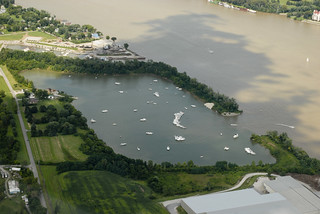
Ohio River near Louisville

Ohio River near Louisville, KY

Over the weekend I was searching out some new links to the Pryors in Louisville, Jefferson County, Kentucky. I’m still looking for solid connections to the correct John Pryor who was the father of explorer Nathaniel Pryor. I thought I’d share some of my finds in case they help to spur your insights into the family line.

19th Century Louisville Silversmiths

I’ve been intrigued with the story of Nathaniel “Miguel” Pryor, the Kentuckian who settled in California. His trade was recorded as “platero” or silversmith. That’s something that was usually learned by an apprenticeship back in those days. I had never heard of Louisville as a place reknowned for silverwork– I guess Paul Revere and Boston take the forefront in American silversmithing. Apparently there were a few smiths in Louisville. I found the names and working dates for silversmiths in Louisville: Richard E Smith (1827), Smith & Grant (until 1831), William Kendrick (1840), and John Kitts (1838).  A mint julep silver cup made by Kendrick even made it’s way on to the Antiques Road Show.  Pryor could have even learned the trade when he moved west as there were numerous fine silversmiths in St. Louis. (See Missouri’s Silver Age: Silversmiths Of The 1800s By Norman Mack)

Amherst County and Louisville Connection

I still keep coming back to David Crawford’s 1801 Will (See transcript of the will). It was filed in Louisville, mentions land owned Amherst County, VA, and it was witnessed by John and William Pryor. Nelson Crawford who was mentioned in the will witnessed a deed in Amherst County with Jonathan Pryor in 1817, as well as Charles Taliaferro who was also on the will. If you go back a few decades to 1774 when William Pryor and wife Margaret of Amherst County deeded land to Philip Thurmond, David Crawford was a witness.

So the Crawfords lived near William and Margaret Pryor. We know for sure that William and Margaret had sons Nicholas, William and John — William filed for a pension in 1832 and John saved Fort Donnally with Philip Hammon. Was it this William and John Pryor who were witnesses to David Crawford’s will in Louisville?

Pryor Land In Kentucky

In a recent post (Identity of John Pryor – Revolutionary War Bounty Land in Kentucky) I dug in to Revolutionary War land warrants to ID which John Pryor received land in KY.  Wait! There are more KY land grants to solve. Elizabeth Pryor Harper in her book Twenty-One Southern Families: Notes and Genealogies mentions 3 military land grants in 1791. These are a bit of a mystery to me because I didn’t find them on the State of Kentucky website with the other grants.  These grants on Beaver Creek and Skaggs Creek, these locations are in Pulaksi County and Rockcastle County respectively (see State of KY Gazetteer). The grants may have been filed in Jefferson County, but the land wasn’t in that county!

Musing over where these grants were recorded and where the land was at and which John Pryor was the recipient may all be for nothing because Ms. Harper noted next to each grant that they were “withdrawn”. There are no known Pryors in the records near the time in Pulaski or Rockcastle County. Does withdrawn mean that a claim was made without follow through?


Identity of John Pryor – Revolutionary War Bounty Land in Kentucky

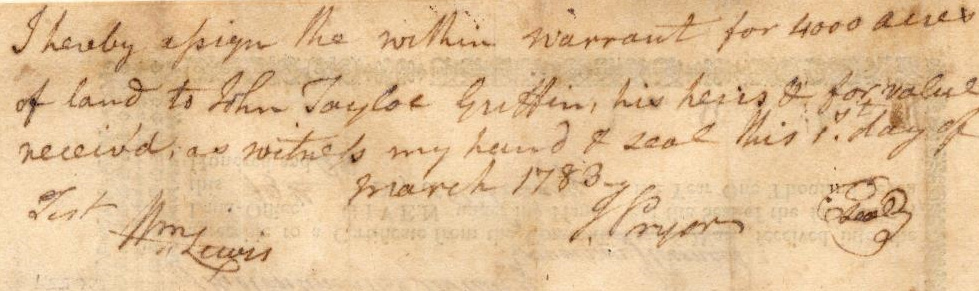
major-pryor-warrant2


Long ago I stumbled upon the data from Elizabeth Pryor Harper’s book Twenty-One Southern Families: Notes and Genealogies. It references a  4000 acre millitary land warrant to John Pryor in Kentucky.  In addition she states the same John Pryor was “Supposed to have been killed by Indians before 1825.” [view online]  It’s time to reveal which John Pryor got the military land and prove Ms. Harper wrong– this is not the John Pryor who was killed by Indians. And this may not be the John Pryor you expect!

It’s Major John Pryor of Richmond, VA.  The aging Revolutionary War vet who was deserted by his first wife, Anne Beverly Whiting. Don’t know who he is? Read more…

The Major’s second wife, Elizabeth Quarles Graves, filed for a widow’s pension for his Revolutionary War Service. There’s a easy-to-read transciption of the pension application online at https://revwarapps.org/w12064.pdf. It’s important to read the application, especially the last paragraph on page 2. This paragraph states that John Pryor held the ranks of Lieutenant and Captain-Lieutenant. I don’t think he ever held the rank of Major– it was probably a respectful title like “Colonel” in the South.

The land warrants and the pension application match up. On both records John Pryor is a Captain Lieutenant. The Warrant number matches up to John Pryor’s land grant: The grant number was  0126.0 while the pension states it was 1760 (I think the “2” was misread as a “7”) on the transcription of his pension (above).The actual land warrants can also be viewed online through the state of Kentucky website.  apps.sos.ky.gov/land/military/revwar/Revdetail.asp?Type=w&warrant=0126.0.

There were 4 grants given to John Pryor under this warrant number.

1.  Location: Kentucky – on the Cumberland River, near upper corner of C. Carrington’s survey.
Assignee: John Tayloe Griffin
Grant date 9/17/1785.
Received 1000 acres

2. Location: Kentucky – on the Muddy River
Assignee: John Tayloe Griffin
Grate date (surveyed) 7/15/1786
Received 1000 acres

3. Location: On the east side of the Little Miami, later pencil note on document states “land is in Ohio”
Assignee:  John Tayloe Griffin, assigned to Robert Morris
Grant date: (surveyed) 4/17/1788
Received 1000 acres

4. Location: Cypress Creek
Assignee: John Tayloe Griffin, Robert Morris assignee
Grant Date: (surveyed) 12/28/1786
Received 1000 acres

major-pryor-warrant

There’s no indication that Major John Pryor resided anywhere but Richmond, VA and probably never saw his bounty land in Kentucky.  He assigned or sold the land to John Tayloe Griffin who was also from Richmond.  I wonder what Griffin’s connections were to the Tayloe family: Major Pryor bought a race horse named Federalist from the estate of John Tayloe per an 1829 racing journal.

With the mention of “Captain” Pryor and a Tayloe connection, it may be time to read another post again and decipher the mystery of Grandma’s Clock [read the post]. And who is the C. Carrington on the first warrant. Could this be Codrington Carrington, son of George Carrington of Cumberland  Co., VA [see deeds] and Fayette Co., KY?

And it’s time to dig out the July 1825 edition of the Louisville Morning Post to find out which John Pryor that Elizabeth Pryor Harper found had been killed by Indians.

Pryor Brothers: Thornton and Samuel

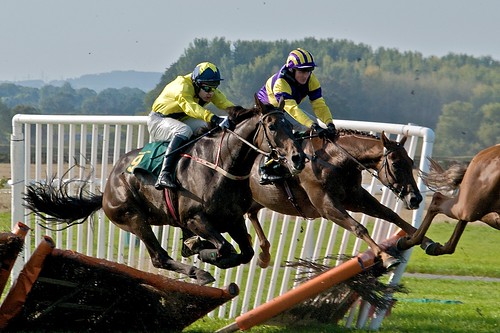
Race Horses Crash Fence

I know… there are alot of Thornton and Samuel Pryors, so I should clarify which brothers.  Thornton born about 1781 and Samuel born between 1760 – 1785 were the sons of Joseph Pryor of Botetourt County, VA and his wife Mary Flemming. They were grandsons of Col. Samuel Pryor and Prudence Thornton.

Recently I spent some time searching and reading through Revolutionary War Pension applications. I didn’t find on filed for Joseph Pryor, however I found that serveral men who had filed for pensions claimed to have served under Capt. Joseph Pryor of Botetourt County. I’ve posted quotes that contain information of where they marched and fought while in his companty (read more).  The last record I found of Joseph Pryor in Virginia was when he sold 3 slaves in 1800. He was recorded that same year in Woodford County, KY.

Based upon the date  of his will, Joseph Pryor died in Bourbon County around 1813. His sons Samuel and Thornton were named in his will.  I’ve found traces of Samuel and Thornton in Tennessee and beyond, slowly piecing together their family trees.

I suspect that Samuel and Thornton traveled to Tennessee as part of their ventures in breading thrououghbread horses. In 1806 there was unclaimed mail for Samuel Pryor and Thornton Pryor at the Nashville Post Office. I found in “The Papers of Henry Clay” (yes, the same Henry Clay who was a politician and a statesman!) “Thornton was the brother of Samuel Pryor, trainer and part owner of the horse, Truxton, which raced under Andrew Jackson’s colors.” And, yes indeed this was the same Jackson who became the hero of New Orleans in the War of 1812, later the seventh president of the United States and the guy on the twenty dollar bill. I did some more searching to when General Andrew Jackson owned Truxton and found a 1832 statement that claimed Truxton was sold to Jackson twenty-five years earlier; in about 1807, by “Samuel Pryor of Kentucky.”

It’s facinating how it all comes together! Gen. Jackson was from Middle Tennessee. 1807 is about the time letters were held in Nashville for Thornton and Samuel.  In 1814 Thornton Pryor was accused in an assault case in Robertson County, TN;  I suspect this is the same Thornton Pryor.

The last known records I’ve found of Thornton Pryor was the petition he filed in 1828 concering his father’s estate and then the 1830 Census in Owen Co., KY.

I suspect that Samuel Pryor, the one who sold Truxton to Jackson, is the Samuel Pryor counted on the 1830 Census in Montgomery County, TN. In 1830 this Samuel was 50 to 59 years old (born between 1771-1780) which makes him the right age to be a son Joseph and Mary Pryor.

The Samuel in Montgomery County had only one known child, although there were several younger peopel recorded in his household on the 1830 census. Samuel’s known child was Edward L. Pryor who married Martha A Ryburn and then in 1845 he settled in Hemstead County, AR.  When Edward arrived in Arkansas there was already a Richard Pryor born in Virginia and living in Hempstead County.   Both men appear to have been literate and prominent in the county: Richard was a postmaster and Edward L. a census taker.  Richard Pryor was the trustee of the Spring Hill Male Academy. I haven’t ruled out that Richard and Edward were brothers, however there was only one male 20-29 years old in Samuel’s house in 1830 and that was most likely Edward L.

If you’ve been reasearching this line, please share by commenting!

SOURCES:

American Turf Register and Sporting Magazine, Volume 4 by J S Skinner, publ.  September 1832.

The American Race Turf Register, Sportsman’s Herald and General… by Patrick Nisbett Edgar of Granville County, NC in 1833

Making the American Thoroughbred: Especially in Tennessee, 1800-1845, by James Douglas Anderson, Balie Peyton